Iqbal, Sir
Muhammad, philosopher, poet, and political leader, was born in 1873
at Sialkot.Iqbal did not live to see the creation of an independent
Pakistan in 1947, he is nevertheless regarded as the symbolic father
of that nation.
Indian Muslim
poet, philosopher, and political leader. He studied at Government
College, Lahore, Cambridge, and the Univ. of Munich, and then he taught
philosophy at Government College and practiced law.
He was elected
(1927) to the Punjab provincial legislature and served (1930) as president
of the Muslim League. A staunch advocate of Indian nationalism, he
became a supporter of an independent homeland for India's Muslims,
though within an Indian federation and not as a separate nation.
He is regarded
by many as the spiritual founder of Pakistan. Iqbal was the foremost
Muslim thinker of his period, and in his many volumes of poetry (written
in Urdu and Persian) and essays, he urged a regeneration of Islam
through the love of God and the active development of the self. He
was a firm believer in freedom and the creative force that freedom
can exert on men.
Allama Muhammad
Iqbal is generally known as a poet and philosopher, but he was also
a jurist, a politician, a social reformer, and a great Islamic scholar.
People even bestowed on him the title of "Shaere-Mashriq"
(Poet of the East!). It may sound strange that Iqbal never considered
himself a poet as is evidenced by his correspondence with Syed Sulaiman
Nadvi [1885-1953].
"I
have never considered myself a poet. Therefore, I am not a rival of
anyone, and I do not consider anybody my rival. I have no interest
in poetic artistry. But, yes, I have a special goal in mind for whose
expression I use the medium of poetry considering the condition and
the customs of this country."
(translated from the original in Urdu; Maktoobat, Volume I, page195)
(translated from the original in Urdu; Maktoobat, Volume I, page195)
The central theme and main source
of his message was the Quran. Iqbal considered the Quran not only as
a book of religion but also a source of foundational principles upon which
the infrastructure of an organization must be built as a coherent system of
life. According to Iqbal, this system of life when implemented as a living
force is ISLAM. Because it is based on permanent (absolute) values given in
the Quran.
In Iqbal's opinion, Islam is not a religion in which individuals strive for a private subjective relationship with God in the hope of personal salvation as it is done in secular systems. Iqbal firmly opposed theocracy and dictatorship and considered them against the free spirit of Islam.
He thought that humanity, as a whole has never faced the challenge posed by the enormity and the complexity of human problems, such as it is facing today. The problems have taken on a global dimension now and transcend the barriers of race, color, language, geography, and social, political and religious ideologies.
Most of the problems of mankind are universal in nature and, therefore, require a universal approach to the solution. Iqbal's universal message is an attempt to address this challenge faced by humanity.
Through his travels and personal communications, Allama Iqbal found that the Muslims throughout the world had detached themselves from the Quran as a guiding principle and a living force. After the disaster following the Balkan War of 1912,the fall of the caliphate in Turkey, and many anti-Muslim incessant provocation's and actions against Muslims in India (1924-27) and elsewhere by the intellectuals and so called secular minded leaders.
Allama Iqbal suggested that a separate state should be given to the Muslims of the Indian subcontinent so that they can express the vitality of Islam to its fullest. In his 1930 Presidential speech delivered to the annual session of Muslim League at Allahabad, Allama Iqbal stated:
In Iqbal's opinion, Islam is not a religion in which individuals strive for a private subjective relationship with God in the hope of personal salvation as it is done in secular systems. Iqbal firmly opposed theocracy and dictatorship and considered them against the free spirit of Islam.
He thought that humanity, as a whole has never faced the challenge posed by the enormity and the complexity of human problems, such as it is facing today. The problems have taken on a global dimension now and transcend the barriers of race, color, language, geography, and social, political and religious ideologies.
Most of the problems of mankind are universal in nature and, therefore, require a universal approach to the solution. Iqbal's universal message is an attempt to address this challenge faced by humanity.
Through his travels and personal communications, Allama Iqbal found that the Muslims throughout the world had detached themselves from the Quran as a guiding principle and a living force. After the disaster following the Balkan War of 1912,the fall of the caliphate in Turkey, and many anti-Muslim incessant provocation's and actions against Muslims in India (1924-27) and elsewhere by the intellectuals and so called secular minded leaders.
Allama Iqbal suggested that a separate state should be given to the Muslims of the Indian subcontinent so that they can express the vitality of Islam to its fullest. In his 1930 Presidential speech delivered to the annual session of Muslim League at Allahabad, Allama Iqbal stated:
"I,
therefore, demand the formation of a consolidated Muslim state in the best interests
of India and Islam. For India, it means security and peace resulting from an
internal balance of power; for Islam, an opportunity to rid itself of the stamp
that Arabian imperialism was forced to give it, to mobilize its laws, its education,
its culture, and to bring them into closer contact with its own original spirit
and with the spirit of modern times."
Iqbal Wrote many Poems
to encourage people and one of them is given below:
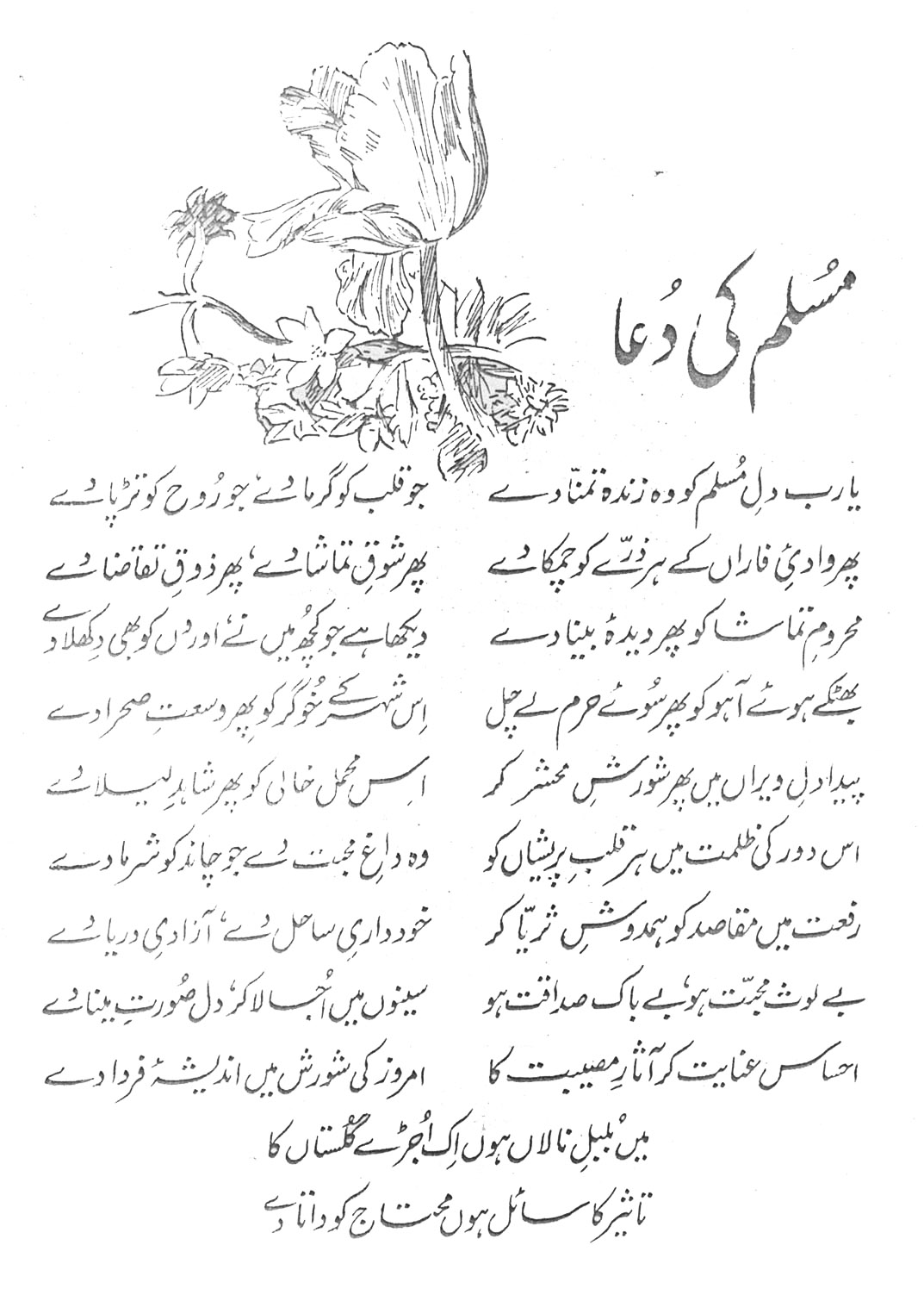
As a poet Iqbal represented in perhaps the most sensitive manner, the collective consciousness of his people during a certain period of their history. He was able to do so because he maintained a constant and direct contact with his audience at all levels. In the old days the institution of the 'Mushaira' helped the poet to maintain such a contact. But the 'Mushaira' was an exclusive club of the literary and the social elite. By the time Iqbal appeared on the seene poetry was no longer the monopoly of a tiny minority. Iqbal was not a poet of the 'Mushaira'.
He was instead a poet
of the 'Jalsa'. His audience was not the social elite but the common folks.
Unlike the modern Urdu poet who followed him, Iqbal was not writing for a public
he did not know, nor was his public listening to a poet it did not understand.
There
Is More:

No comments:
Post a Comment